



During the National Prayer Breakfast on February 5, 2026, Paula White-Cain lauded President Donald Trump as a significant advocate for faith, prompting Trump to assert he has done more for religion than any previous president. This raises the question of whether political leaders should endorse religious causes, a stance resonating with some supporters of Christian nationalism—a diverse concept ranging from simple Christian patriotism to the belief that the U.S. should be governed by Christian principles.
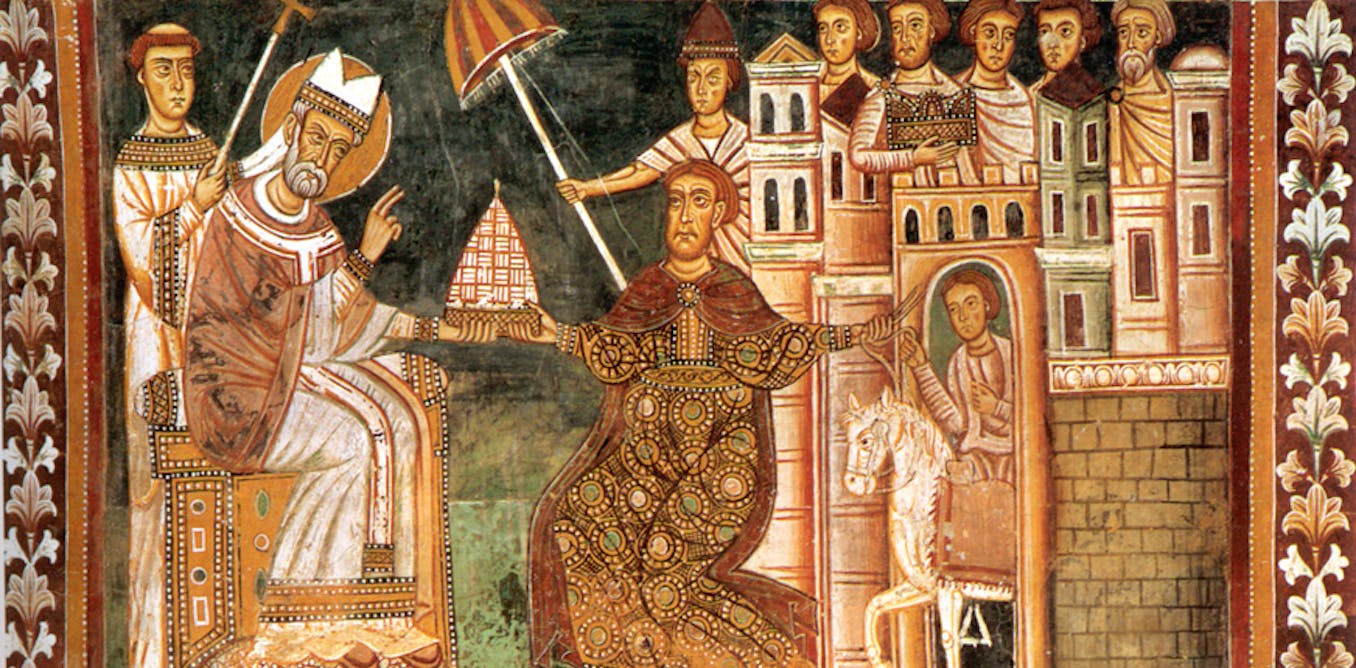
The idea of “Christendom” is explored, recalling a millennium of Christian influence in European politics and society from approximately 500 to 1500 CE. This period is viewed nostalgically by some conservatives, representing a time of unity between church and state. However, such historical interpretations can gloss over the nuanced realities of medieval Christianity, which included varied communities and a lack of consensus on church-state relations.
Key historical figures like Eusebius of Caesarea and Saint Augustine offer contrasting perspectives on the relationship between faith and empire. Eusebius celebrated the merging of Christian and imperial authority during Constantine’s reign, heralding a time when Christianity gained favor linked to political power. In contrast, Augustine emphasized skepticism about earthly rulers’ capacity to represent divine ideals, suggesting true fulfillment lies not in political conquests but in serving God’s mercy.
The article concludes that there is no singular Christian viewpoint regarding faith and political power, highlighting the complexity of Christian thought throughout history and its implications for contemporary discussions around Christian nationalism and jingoism.
