



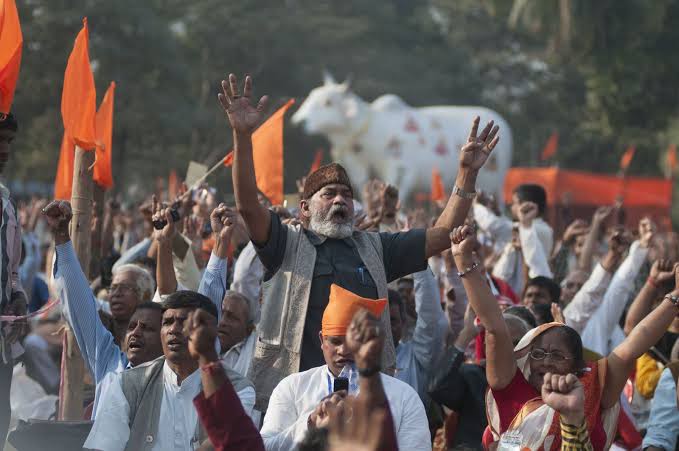
The article by Bhabani Shankar Nayak discusses Hindutva as a political ideology that critics argue is influenced more by modern global ideologies and power structures than by India’s historical pluralism. Scholars suggest that Hindutva has roots in early twentieth-century European nationalist movements and that its rise coincided with British colonial divide-and-rule tactics. The Rashtriya Swayamsevak Sangh (RSS), founded in 1925, is noted for disseminating Hindutva while largely distancing itself from the broader anti-colonial movement.
Recent decades have seen Hindutva’s expansion alongside neoliberal economic policies, which critics claim increased social inequalities that were effectively mobilized through appeals to nationalism and cultural identity. Despite governmental rhetoric under leaders like Atal Bihari Vajpayee and Narendra Modi, critics argue there has been no significant shift from neoliberal policies; instead, a consolidation of corporate interests and state power reflects crony capitalism.
Observers note that some Western elites have framed Hindutva governance as stable and modernizing, often aligned with corporate interests rather than purely democratic values. This perspective contends that Hindutva undermines democratic institutions and norms, weakening citizenship by centering identity politics while criminalizing dissent. Critics argue it perpetuates existing social hierarchies, including caste-based inequalities, while expanding economic disparities.
The invocation of Gandhian socialism by the BJP is viewed as contradictory to its actual policies, which critics say deepen divisions and open key sectors to market interests. While Hindutva differs from European fascism, it shares structural features like majoritarianism and centralization of power. The article concludes that resisting Hindutva’s influence is essential for upholding India’s pluralism and democratic framework, highlighting the ongoing debate about nationalism, democracy, and development in contemporary India.
