


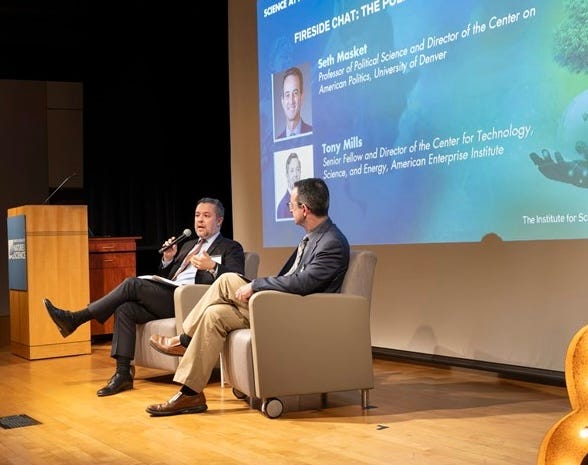
The author participated in a symposium at the Institute for Science & Policy, engaging in a “fireside chat” with Tony Mills from the American Enterprise Institute. They focused on the significant partisan gap in trust towards science, particularly during the Trump Era, which intensified prior to the COVID-19 pandemic due to populist anti-science rhetoric. Mills provided data showing a historical perspective on this distrust, indicating that while current polarization is notable, similar trends occurred in past decades, such as the 1970s, when liberals distrusted scientific achievements linked to the military-industrial complex.
Additionally, the 1950s had its own anti-science sentiment, rooted in intellectual criticism and red-baiting led by figures like Sen. Joe McCarthy. This era shifted with the 1957 launch of Sputnik, which sparked a resurgence of faith in science as a response to the Soviet threat. Mills likened the COVID-19 pandemic to a modern-day Sputnik moment that, instead of unifying Americans around science, was marred by polarization and skepticism, often fueled by political discourse.
The discussion highlighted the challenges scientists face in rebuilding trust amidst accusations of political bias in their work. While the current anti-science climate, predominantly driven by Republican sentiments, is expected to fade, the conversation left open what might catalyze a renewed trust in science.
