



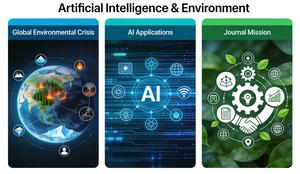
The newly launched journal “Artificial Intelligence & Environment” (AI&E), co-edited by Professors Guang-Guo Ying and James P. Lewis, aims to explore the innovative use of AI in tackling eco-environmental challenges, including climate change, pollution control, and sustainable development.
In its inaugural issue, six key papers outline the field’s direction. The editorial emphasizes that AI is designed to augment, not replace, the work of environmental scientists by enhancing data processing and analytical capabilities.
Key highlights include:
-
Proactive Design in Pollution Analysis: Machine learning is revolutionizing pollutant identification, moving towards a standard-free analytical approach in environmental chemistry.
-
Microplastics Framework: A comprehensive AI approach is proposed to tackle the interlinked issues of microplastics, climate change, and biodiversity loss.
-
Holistic Intelligence: The review of AI applications in diverse environmental fields provides guidelines for implementing transparent AI models.
-
Urban Exposomics: Research indicates that pet hair can serve as a sensor for indoor pollution, revealing shared chemical exposure between pets and owners.
-
Global Governance: Examining the different AI development paradigms in China, the US, and the EU highlights the complexity of achieving unified environmental governance amid diverging technological frameworks.
AI&E seeks submissions for original research and proposals for special issues, fostering knowledge exchange among global researchers dedicated to environmental protection.
