



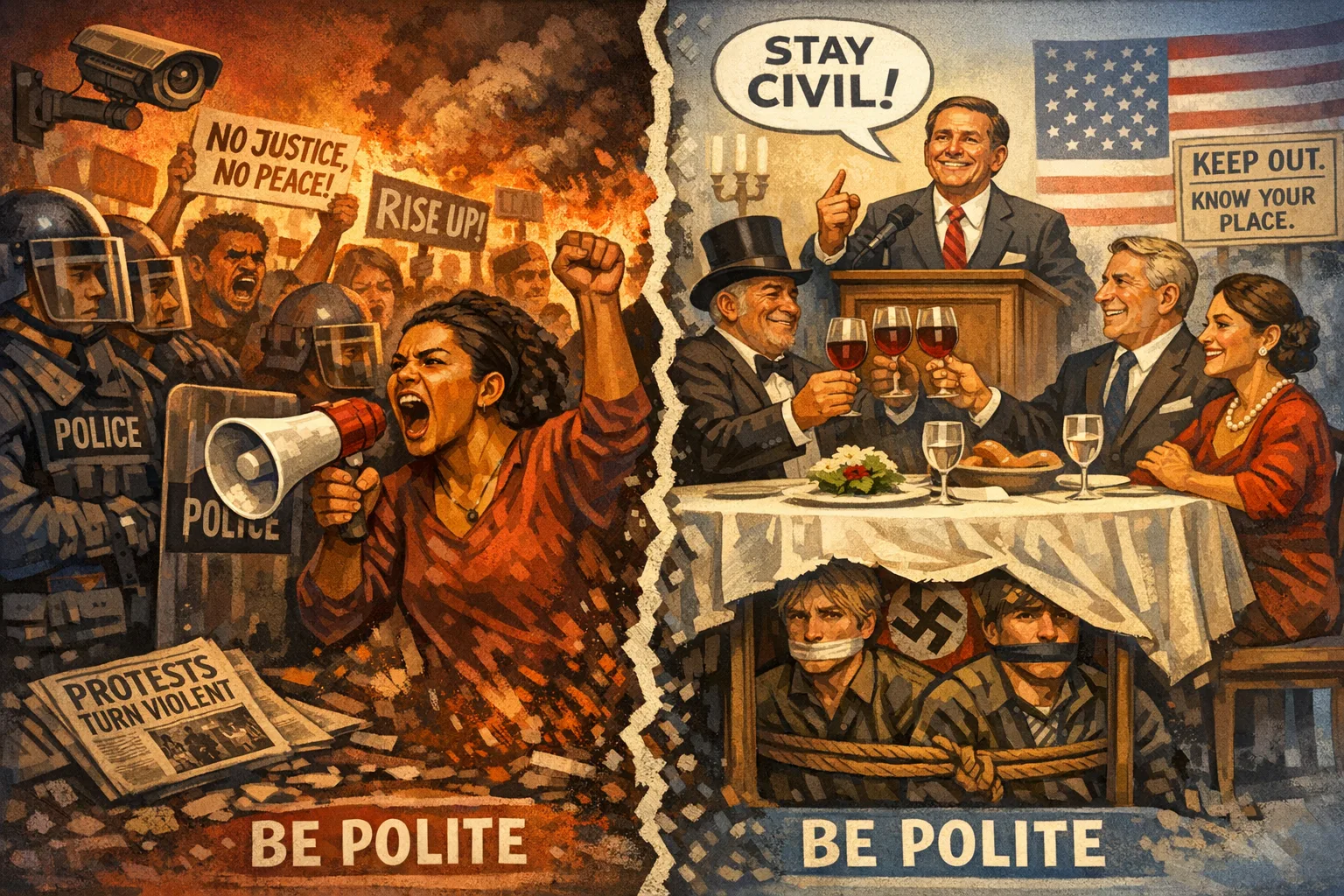
The article argues that “respectful discourse” often silences dissent and contributes to the rise of fascism. It emphasizes that rather than addressing critical issues, conversations are redirected to focus on how critiques are expressed, sidelining their substantive content. This shift enables those in power to avoid accountability.
The author highlights that civility is often incorrectly viewed as foundational to democracy. In reality, enforcing civility selectively restricts dialogue, framing anger—an important indicator of social harm—as irrationality. This creates an environment where polite exclusion and bureaucratic cruelty are normalized, while passionate resistance is seen as extremism.
The text also discusses the “tolerance paradox,” where authoritarian expressions are tolerated if delivered respectfully, while anti-authoritarian sentiments are dismissed as disruptive. Over time, this breeds compliance and discourages genuine accountability, paving the way for overt repression.
Ultimately, the article posits that a society prioritizing politeness over truth becomes complicit in its own oppression, creating fertile ground for fascism. It argues for the importance of clarity and accountability over mere civility, as the latter can become a tool of control.
