


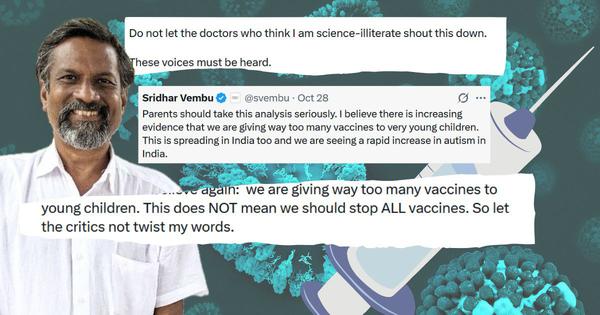
Sridhar Vembu, the founder of Zoho, recently endorsed a controversial report linking vaccines to autism, lending credibility to unscientific claims that could have politically dangerous implications. The McCullough Foundation Report, co-authored by discredited figures like Andrew Wakefield, presents itself as a scientific review of autism causes but is essentially a curated opinion piece that misrepresents scientific evidence.
Vembu’s endorsement exemplifies a growing trend where technocrats and fragmented media recast fringe views as “brave dissent.” The report frames vaccination as a key risk factor for autism, utilizing anecdotal evidence while dismissing large-scale studies proving no link. This approach reflects a broader rise of counter-expertise that prioritizes personal anecdotes over peer-reviewed science.
Vembu’s comments challenge traditional scientific authority, promoting a narrative that valorizes those questioning institutions. However, this rhetoric risks undermining public trust in vaccinations, perpetuating misinformation while ignoring the social consequences. Misinformation worsens existing inequalities, particularly affecting marginalized communities who may hesitate to vaccinate their children due to fear and mistrust.
The article argues that Vembu’s actions signify a shift in how science is perceived, turning it into a battleground of competing claims rather than a collaborative public good. It advocates for a reimagining of public discourse around science, emphasizing the need for mutual accountability and shared inquiry to foster vaccine confidence and scientific integrity.
